ABANILLA
Pza. de la Constitución, 1
30640 - ABANILLA
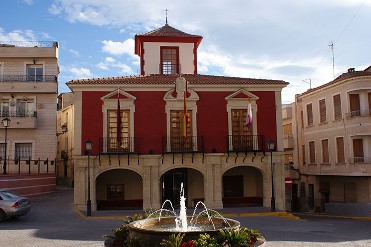
The Town Hall is a civil building of the 18th century, which was built between 1751 and 1762 during the reign of Ferdinand VI of Spain. This building preserves the windows, iron fittings and mouldings from that period. It worked as a royal prison and granary, whose access door has been recently discovered in the south after a renovation of the facade. Its interior is functional and mainly for administrative use. Its facade and surroundings are also relevant.
ÁGUILAS
Peña Tejada-Cerro de las Águilas
30880 - ÁGUILAS
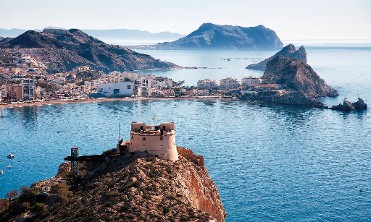
The Castle of San Juan de las Águilas perches on top of the headland of Punta Negra and a raised platform wich has attracted human settlers since prehistoric times. Archaeological investigations have revealed remains dating from the Chalcolithic, or Copper Age, including fragments of hand-crafted ceramics, flint tools and polished stone axes, one of wich is made from diorite and is now housed in the local Archaeological Museum. These materials belonged to groups of individuals who devotes themselves for a time to the collection of mollucs and other marine species along the coastline. In relation to the period of roman rule, excavations have uncovered numerous structural remains and materials: amphorae, common and luxury ceramics. Construction of the castle as we see it today dates back to 1756 during the reign of Fernando VI and was designed by military engineer Sebastián Feringán. It has been awarded Item of Cultural Interest status in the category of "Monument" and is inextricably intertwined with the history of Águilas: the foundation of the modern town coincided with the period when it was being built in the middle of the XVIII century. There are three main elements in the fortification: On the western side is the Fortress of San Juan, wuth a central courtyard, an artillery plattform, a first floor intended for accomodation and the kitchen and a ground floor used as a warehouse, gunpowder and prison. To the east is the gun battery of San pedro, where the guns and barbettes for defending the port were housed, and in between them a communication wich includes the forts of San José and San Felipe (whose role was to complete the defence of the stronghold.) Its restoration managed the defintely recovery od the castle, and now that it is fully visitable it is one of the most important examples of the town.
CALASPARRA


Santurario de Nuestra Señora de la Esperanza
30420 - CALASPARRA
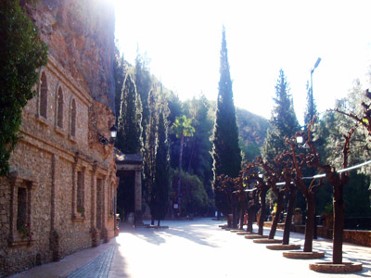
The sanctuary is situated in a cave carved into the rock 6 km away from the town of Calasparra. The first information about it dates from the17th century. Two statues of Our Lady of Hope known as La Pequeñica (the Tiny One) and La Grande (the Big One) are kept in this sanctuary. According to the legend, the small statue was found by a shepherd who sheltered his cattle in this cave sculpted by the river Segura. The local people of the village tried to move the statue to the town of Calasparra but, due to its weight, they understood that the Virgin prefered to be venerated in this cave. The reason why and the date when the bigger statue of La Virgen de la Esperanza appeared remain unknown. In the year 1786, they were already both venerated.
CARAVACA DE LA CRUZ

C/ Cuesta del Castillo, s/n
30400 - CARAVACA DE LA CRUZ
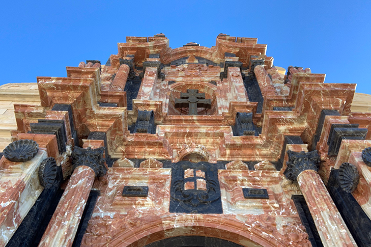
The monument consists of two clearly differentiated parts: the walls and the sanctuary. Despite its Islamic origins, the monument has undergone many changes. Nowadays, fourteen different shaped-and-sized fortified towers are spread along the wall. The fortress belonged first to the Order of the Temple, and later to the Order of Santiago ¿a Spanish Christian military order. Moreover, the castle was used for military purposes during the Spanish Succession War and the Peninsular War. The Santuario de la Stma. y Vera Cruz (the Holy True Cross Sanctuary) was built in the heart of the old fortress in the 17th century. Then, in the 18th century, its magnificent baroque façade was annexed to the sanctuary. The monument as a whole, whose guidelines resemble those of the Monasterio del Escorial (El Escorial Monastery, Madrid) was declared a national Artistic-Historical Monument in 1944. No doubt the presence of the Vera Cruz (the Holy True Cross) has contributed to the sanctuary preservation. The church has a Latin-Cross plan, a continuous gallery over the lateral naves, and also a dome over the transept. Recently, the Museo de la Santa Vera Cruz (the Holy True Cross Museum) has been reopened in the sanctuary rooms. Telephone: 968 707 743 968 708 540
CEHEGÍN
Casco Histórico de Cehegín
CEHEGÍN
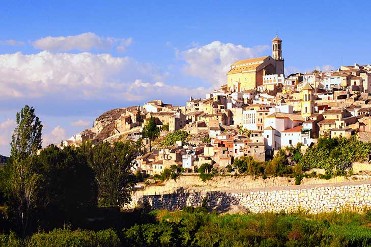
Declared a Historic-Artistic Site in 1982, there are many examples of popular architecture from the 12th to 19th centuries, including the Palacio Villar de Felices, the Palacio de Jaspe, and the Casa del Conde de Campillos with heraldic examples of great interest to researchers. Religious architecture includes the Church of Santa María Magdalena, the Church of La Soledad, the Church of La Concepción and the Hospital de la Real Piedad, and in the Ensanche area, the Convent of San Esteban. There are also abundant prehistoric remains such as the cave paintings of Peña Rubia and Begastri, a late Roman and Visigoth city which was the Episcopal see until the 8th century AD. There is also a Municipal Archaeological Museum and a private Ethnological Museum, belonging to the Duke of Ahumada, and its Historical Archive.
CIEZA
Balcón del Muro
30530 - CIEZA
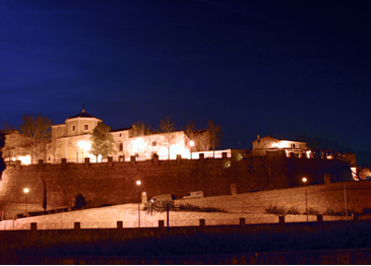
The Wall Balcony is witness to important historical events such as the bloody take-over of the town by Abu-I-Hassan and his troops from Granada wich gave the town its motto found on the crest: "For crossing the birdge the gave us death". The town was sacked and its inhabitants made prisoners. This Balcomy was completed in 1898.
JUMILLA
Castillo
30520 - JUMILLA
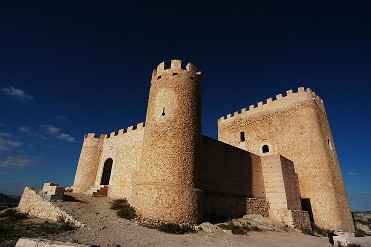
In 1461, the Marquis of Villena built the fortress, as we know it today, in Gothic style, with three floors, a cellar and a terrace, where he put his coat of arms. The Torre del Homenaje (Keep) is a rounded tower in order to cushion the impact of the cannon balls. The cellar or basement was used as dungeon and as a place to reserve food and water. The first floor or Sala del Bastimento (Supply Room) is the place where the weapons of the troops used to be kept and it also was the defence of the Castle. Nowadays it does not exist because it was destroyed on a fire during the Peninsular War. The second floor or Sala del Alcaide (Governor Room) is the most important room, with a main hall and the residence of the jailer. The door of entry, with a portcullis, is placed in this floor. The third floor or planta de la tropa (floor of the troops), is the place where the oven and the forth floor or terrace used to be. There are two wells of the Arabic time in the Patio de Armas (Parade Ground). The original access to the Castle is el Camino del subidor (The Road of the Raiser). These days, the Castle of Jumilla has became an exhibition space where tourists can learn about the different stages and elements of its construction.
LORCA


Castillo
30800 - LORCA
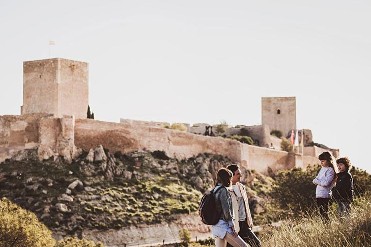
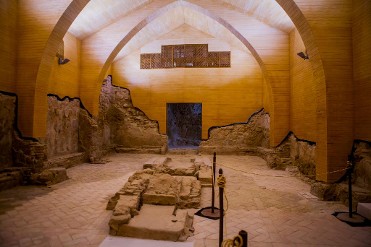
The Castle of Lorca is an ancient medieval fortress from the 11th to the 13th centuries. It was used over time to defend the border between the kingdoms of Murcia and Granada. It was in use until well into the 16th century. During the War of Independence (1808-1814) it was again used as a place of refuge and defence. Today it hosts a recreation and exhibition of the Middle Ages. Here you can visit the towers, cisterns and the archaeological remains of the Synagogue from the 15th century. Translated with www.DeepL.com/Translator
MURCIA
Plaza del Cardenal Belluga
30001 - MURCIA
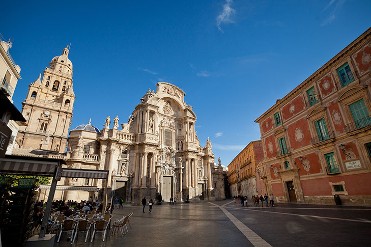
The most important temple in the Region is a magnificent merge of styles, a catalogue of stone which summarizes more than six centuries of art and history. Its construccion began in 1394 over the remains of an old Arabic mosque and in 1462 its vaults were finished. The oldest entrance is La Puerta de los Apóstoles (the door of the Apostles). Its only storefront is flanked by pointed archivolts with statues of the apostles on it. La Puerta de las Cadenas( the door of the Chains) dates from 1513 and has original pilasters and archivolts. From the 15th century dates the Capilla de Los Vélez covered by a ten-pointed star vault and profusely decorated. Another famous chapel is that of Junterón, whose oval ground plan is covered by an extremely original vault. Its baroque main façade (Imafronte), Jaime Bort¿s work, is an exaltation of levantino art (the 18th century eastern Spain art). It is divided as an altarpiece into two parts and three vertical sections. The tower, divided into five parts, is 92 meters high. Its construction started in 1511 and the fifth body hosts twenty-five church bells
PUERTO LUMBRERAS
Cerrado temporalmente
Cerro del Castillo, junto a la rambla del mismo nombre
30890 - PUERTO LUMBRERAS
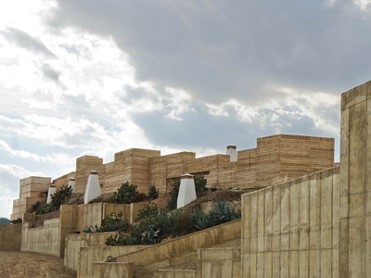
Medieval Islamic castle built between the twelfth and thirteenth centuries, whose strategic location at the confluence of the Rambla de Nogalte and the Guadalentín Valley, allowed to exercise control over these natural communication routes that linked the Levant with Andalusia. In the surroundings of the castle there is a group of Cave Houses, which have been adapted as tourist spaces. These caves can be visited through a tourist-cultural itinerary along which visitors can learn about the history of the Islamic fortress, along with the caves used as homes for centuries, the importance of water or crafts for the local economy . The route offers pedestrian paths around the Nogalte Castle, as well as several stops in seven thematic spaces that offer the only cave houses that can be visited in the Region of Murcia. The thematic spaces are as follows: Craftsman's Workshop House The four caves that make up this space host the musealization of trades related to the activity of the different entities that make up the Association of Artisans of Puerto Lumbreras, the exhibition of handmade products and the sale to the visiting public. Cave "El Cerro de Nogalte: we recover our history" In this Cave House, the heritage values ¿¿of Cerro del Castillo de Nogalte are presented to the public, through a system of interpretive panels. Cave "Sheltered from Cerro de Nogalte: life and traditions in cave houses". Two Cave Houses that are dedicated to communicating the uniqueness and evolution of the human use of the caves in the southeast peninsular and in Puerto Lumbreras from prehistory to recent times, highlighting aspects such as the evolution of the use of the caves, the troglodyte habitat on the Hill de Nogalte or the socioeconomic and population aspects of these Cave Houses. Cave "The Culture of Water" The importance of water in Puerto Lumbreras is presented, establishing a route in a sense of circulation to present the routes of water from its collection, storage and distribution, to the uses in the different traditional and current activities. Cave "The medieval Nogalte Castle: Islamic enclave" This cave is intended to present the thematic contents of Nogalte Castle, as well as the Guadalentín corridor at border time as well as archaeological research in Nogalte Castle. Audiovisual Cave This space is intended to host a wide cultural program throughout the year with capacity for small groups, paying special attention to the production of local creators. Didactic Cave This cave is intended to support the development of educational and training activities aimed at groups organized through the programming of specific workshops related to the cultural visit to Cerro de Nogalte. Cave School It announces what school and teaching was like in the mid-twentieth century in Puerto Lumbreras, as it was the day to day school, to which children were engaged in their free time. It shows the general characteristics of the school, furniture and teaching materials of the time Enviar comentarios Historial Guardadas Comunidad
SAN JAVIER
Pza. de España. San Javier
30730 - SAN JAVIER
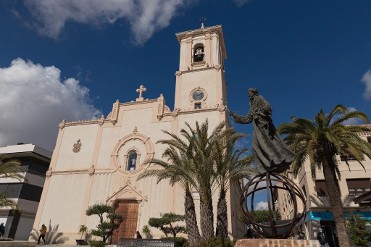
PARISH CHURCH OF SAN FRANCISCO JAVIER The church of San Francisco Javier boasts a rich artistic repetoire inside, consisting of sculptures (almost all of them in carved, painted, and polychromed wood), altarpieces, liturgical items, and more. Its pulpit is also noteworthy, attached to a column and crafted from carved wood. It comprises an octagonal body with a canopy. On its fronts, one can observe the carvings of the four evangeists and an image of Jesus. As unique elements, there’s a dome in the transept over pendentives with an aeight-sidded apse, a dome at the head of the church, a bell tower, and the Baroque altarpiece by Antonio Carrión Valverde. With Latin cross floor plan, its structure consists of barrel vaults supported by load-bearing walls in the enclosures and pilasters in the central openings. This church is home to the parish museum of San Javier. Though small in size, it consists of four different spaces or areas that allow us to approach Catholic devotion and worship through a series of pieces of a varied origin, mostly donated by the residents of San Javier. From a small collection of colonial art pieces donated by Priest Mr. Antonio García Castejón to ornaments and textiles for worship, devotional images, and even some remains of the altarpiece that existed before the fire of 1939. La Plaza de España is the neuralgic and commercial center of San Javier. In 2003, an ambitious project was undertaken to merge the old squares into a single one, with the Town Hall and the church on each side, surrounded by numerous business premises that bring life to the square. San Javier has become the administrative capital of the Mar Menor region due to its abundant services and a comprehensive range of facilities, including courts, property registry offices, social security offices, employment agencies, banks, and notaries, among others. We can enjoy the terraces that remain open all year round, and there is an underground car park that provides convenient parking in the center. The wide square is also the venue for numerous cultural and festive events throughout the year. One of the most important events is the Nativity 'Belen de España,' a Christmas display covering an area of 1,600 m2. The narrow Andrés Baquero street leads to Plaza Cronista Miguel Gallego, another spacious open area with recreational facilities. From there, we can admire the beautifully restored back part of the church.
SAN PEDRO DEL PINATAR
Avda. de Orihuela, s/n
30740 - SAN PEDRO DEL PINATAR
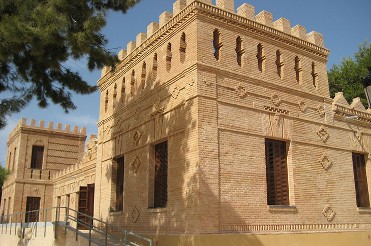
Edificio de grandes dimensiones y línea palaciega. Fue construido por encargo del Barón de Benifayó, quién mandó edificar un palacio semejante en la Isla Mayor del Mar Menor. De estilo neomudejar tiene dos torres almenadas a diferencia del construido en la isla con una sola torre. Alberga el Museo Arqueológico, Etnográfico y las colecciones de juguetes y de material cinematográfico antiguo.
LA MANGA CARTAGENA (LA MANGA DEL MAR MENOR)
Cabo de Palos
30380 - LA MANGA CARTAGENA (LA MANGA DEL MAR MENOR)
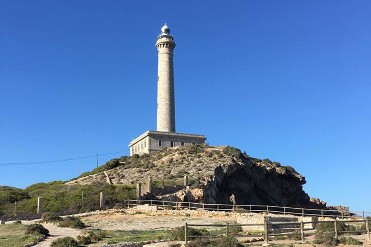
The lighthouse of Cabo de Palos is located on an approximately 600 meters-wide small peninsula in the municipality of Cartagena. Back in its time, there was a watchtower where the lighthouse is currently located. The simple structure is defined by its surveillance function as well as the lighthouse-keepers school which was housed in its base. The construction started in 1863 and the lighthouse was first lit on the 31st January, 1865. The building rises 30 meters above sea level, according to Leonardo de Tejada's project. Ashlar stones brought in from a quarry located in the town of Sabinar were used as building material. It has a prism-shaped base of 20 meters on each side and 14 meters high with rusticated edges. In the middle of the base, above an octagonal shaped pedestal rises the 54 meters high tower. It adopts the form of a Tuscan order column and its capital consists of various corbels that hold up a circular cornice with an openwork parapet in a shape of a balustrade. Above, there is a cylindrical tower where the lantern is built in. Nowadays, it has a beacon with a range of 24 miles.

TORRE PACHECO
Plaza Ayuntamiento, 1
30700 - TORRE PACHECO
Windmills were introduced throughout the Campo de Cartagena from the 16th century onwards. They are of the Mediterranean type and lateen sail. The presence of flour mills was more frequent from the 18th century to the middle of the 20th century and, together with the mills dedicated to the extraction of water, they were essential to the economy of our region. Those preserved in the municipality of Torre Pacheco stand out due to the restoration and conservation projects carried out by the Town Hall itself. These actions have returned these giants to their full monumentality and importance. This structure was initially restored in 1991 and has undergone several interventions in subsequent years. This area has a great agricultural tradition for centuries, with many Roman villas dedicated to the cultivation of cereals documented. Due to this important agrarian tradition, the presence of mills is absolutely necessary to convert wheat into flour or to extract water from the subsoil for irrigation through the conversion of wind power. "El Pasico" Windmill is located next to the Hermitage of Nuestra Señora de "El Pasico", in the well-known district of Hortichuela. It is part of the Campo de Cartagena region, known for the richness and productivity of its soils. The structure of the mill is circular, while its elevation, like all mills of its kind, has a truncated cone shape. It is built from masonry locked with lime mortar and sand, whitewashed on the outside. Its roof is made of wood and is constructed in such a way that it allows the sails to move in the direction of the wind. It has three chambers inside; the upper one contains the machinery needed to grind the grain, the middle one contains the channel through which the flour and the Watt regulator go down, and the ground floor is where the sacks are filled. Nowadays the machinery is completely restored and in perfect condition for use. The documentation found about this windmill tells us how, in the district of La Hortichuela in 1844, a flour mill was documented under the name of Juan Roca Saura, who was the owner until 1855. It was owned by various people until 1910, when Francisco Nieto Cañavete became the owner of the mill known as "El Pasico". The last active miller was Mateo Nieto from 1940 until his death. It now belongs to the Torre Pacheco city council.
TOTANA
Pza. de la Constitución, s/n
30850 - TOTANA
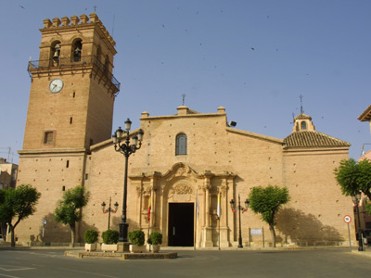
Diversas capillas completan su estructura. Comenzaron a construirse a partir de 1580, siendo una de las más relevantes: la de San Ildefonso (1580), en la que destaca el retablo de la imposición de la casulla por los ángeles al santo titular (tallado en madera). Es, éste uno de los pocos retablos renacentistas de la Región de Murcia que, dedicado a la advocación de San Ildefonso fue encargado para engrandecer la capilla familiar del regidor Alonso Ramos. Otra interesante capilla es la de Ntra. Sra. del Rosario (1664), cuyo primitivo retablo fue realizado por Antonio Caro, conviene visitar también la del Bautismo, la de San Antonio Abad y la de los Dolores. Este templo alberga una magnífica techumbre mudéjar realizada por el lorquino Esteban Riberón. En el altar mayor se encuentra un retablo barroco (1672) con columnas salomónicas, en cuya decoración destacan las hojas de parra. Es obra de Antonio Caro "El Viejo". En su interior podemos contemplar imágenes de destacado valor artístico y religioso, sobresale la de Santa María Magdalena, atribuida a Francisco Salzillo. La talla del titular Santiago, patrón de Totana, es obra de González Moreno. En 1780 se construyó el camarín donde se ubica esta hermosa escultura.
ABANILLA
Pza. de las Cortes (junto al Ayuntamiento)
30640 - ABANILLA
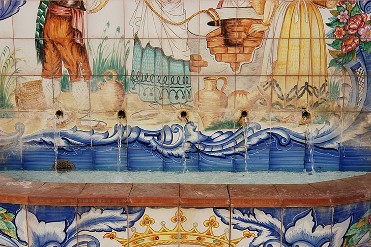
This fountain was placed at the current location after the ancient fountain in the Cañada village (behind the Moorish castle) dried up in 1792. In 1880 a new mine was excavated from the Calle Mayor to the garden of La Lonja and a new flow was discovered, which served to supply the new fountain and its site. The waters are of thermal origin, they flow at a temperature of 20°C and have a composition rich in sulphurous salts, which gives a characteristic flavour and smell. It is decorated with flashy painted tiles which represent iconic moments of people in procession accompanying the Patroness, they also depict the old esparto work which was the main economic motor of the population, the activity became extinct in the 60’s.
ALHAMA DE MURCIA
C/ La Feria, 1
30840 - ALHAMA DE MURCIA
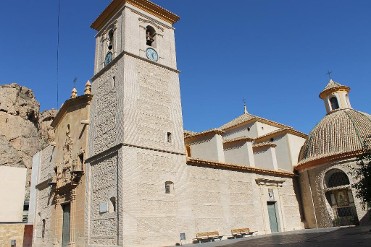
The Iglesia de San Lázaro Obispo is located on the 14th century Christian, dedicated to Saint Lazarus, yet possibly built on the old mosque. The temple was extended in the 16th century under the patronage of the Marquis of los Velez. It was rebuilt in the first half of the 18th century with Baroque architectural aesthetics, highlighting its facade-altarpiece made of ashlar, divided into a three part Baroque facade-altarpiece, made from an advanced Baroque alcove and two towers, one of the three parts has a bell tower and a clock, and the other two are unfinished. The inside consists of a single nave with a barrel vault, lunettes and a rocky decor. On the transept, a dome rises over the pendentives with paintings of the four Evangelists, made by Silvestre Martinez Teruel in the 18th century. Its neoclassical character is reflected in the Communion or Rosary chapel, the sacristy and the safe-keeping room of San Lázaro, works made during the transition between the 18th and 19th centuries, under the supervision of architect Lorenzo Alonso's.
CARAVACA DE LA CRUZ
C/ Mayor, 2
30400 - CARAVACA DE LA CRUZ
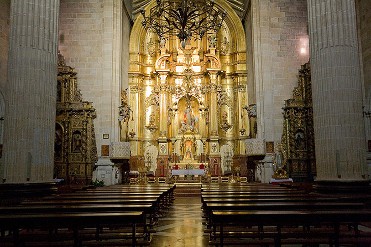
This beautiful sample of religious architecture, treasure of the Renaissance in Caravaca and Murcia, was built between 1534 and 1600. The tower was finished later. It is a hall church, unfortunately incomplete, and it has three naves which rest on wide walls and four columns in Ionic order (of almost two meters in diameter each one), that support the ribbed groin vault at a great height. Around the three naves are distributed seven chapels which construction has been funded by several local noble families. In some of these chapels can be observed wonderful grilles, a piece of work by the artisan Ginés García. In this church is also noteworthy the retable (altarpiece) of the high altar, which was made by José Sáez, from the disentailed church of the Jesuit order. In such a way, the expression of refined painting, goldsmithing and sculpture it offers are worth mentioning. The Iglesia del Salvador (Church of the Saviour) was declared Monumento Histórico-Artístico Nacional (Historic-Artistic Monument of National Interest) in 1983.
CIEZA
Paseo
30530 - CIEZA
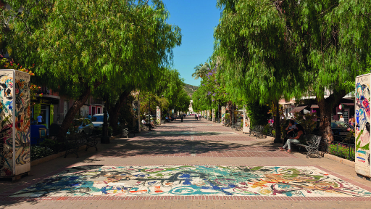
Fue construído en el año 1887 en terrenos en parte cedidos por D. Diego Marín-Barnuevo, de ahí su original nombre de Paseo de Marín-Barnuevo. Tras su construcción, comenzó en torno a él a extenderse la población por la nueva zona del ensanche, proliferando edificios públicos y nuevas casas de la burguesía emergente debido al desarrollo de la industria espartera. Con el correr de los años ha sido objeto de numerosas remodelaciones, siendo la última la efectuada en el año 1986 y en la que el artista ciezano José Lucas realizó una magnífica exposición abierta, (30 columnas y 12 paneles cerámicos en homenaje a poetas y escritores, músicos y pintores de renombre). Una obra en la que lo visual y lo literario se funden en perfecta armonía con el entorno y el paisaje urbano.
JUMILLA
C/ de Santiago
30520 - JUMILLA
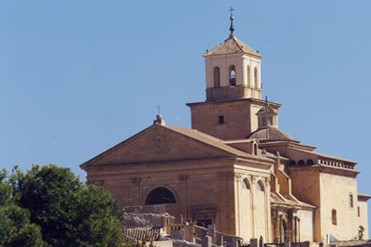
Es Monumento Nacional desde 1931. Su construcción se incia a mediados del siglo XV en estilo gótico tardía o isabelino, edificando sólamente la nave central y las capillas laterales. En el siglo XVI, con el Renacimento, se construye la Capilla Mayor, obra de Jerónimo Quijano; el retablo de 1583, atribuido a los hermanos Ayala, en el que está representada la peregrinación a España del Apóstol Santiago; la Sacristia Vieja; la Colecturía y la Puerta Principal. A principios del XVIII se reinician las obras, con la Capilla de la Comunción, diseñada en estilo barroco, a la que más tarde se le daría salida abriendo la puerta del Perdón, en estilo neoclásico, con dos grandes columnas jónicas. En 1735 se construye la sacristía nueva en estilo barroco, con cornisa corrida y fuertes biselados sobe los dinteles de puertas y ventanas, obra de Pedro Pagán y José de los Corrales. A principios del siglo XIX con el arquitecto Lorenzo Alonso, se construye el coro en los pies de la Iglesia y a ambos lados, sendas naves con puertas de salida al atrio. Todo en el más puro estilo neoclásico pero guardando la armonía con la obra gótica de la nave central.
LORCA
Castillo de Lorca
30800 - LORCA
Archaeological Park of the Castle and Synagogue In medieval Lorca the castle, and under the protection of the Alfonsina Tower, housed the city's Jewish quarter. Excavations in this quarter have revealed what the Jewish houses of the time were like, with a rectangular floor plan, compartmentalised into rooms, and in which spaces can be identified for living rooms, kitchens, storerooms and other rooms that house different uses, as well as benches attached to the wall, jars, cupboards, raised bedrooms, etc. In the Jewish quarter of Lorca, the Hebrews established their synagogue, an exceptional example of Jewish religious art in Spain. The temple was built underground because according to the laws of the time it could not exceed the height of the churches and this, together with the fact that it was never converted into a Christian temple, has allowed the synagogue to be preserved in an exceptional state. The Archaeological Park of the Castle of Lorca has been conceived as a space to enjoy the finds excavated in the Jewish quarter through a walk through the streets of the archaeological remains of the Jewish quarter, discovering what their houses, their offices and traditions were like, and the feeling of Jewish spirituality with a visit to their exceptional synagogue.
SANTIAGO DE LA RIBERA (SAN JAVIER)
Avenida Sandoval
30720 - SANTIAGO DE LA RIBERA (SAN JAVIER)
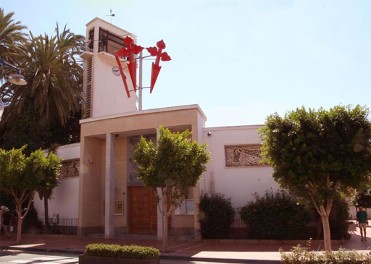
The church of Santiago Apostle, of modern style, has its origins in an old chapel built by the founders of Santiago de la Ribera next to their seaside residence, which in 1968 became a parish. In addition to the scenes and images represented inside, the façade is adorned with crosses in honor of the apostle. In the year 1988, Santiago de la Ribera celebrated its 100th anniversary. The founders of the town, Mr. José María Barnuevo (a member of the Order of Santiago ) and Mrs. Teresa Sandoval, commissioned the construction of their "hotel" or new residence on a plot by Santiago de la Ribera beach. The architectural plans were completed in 1905. At the same time, they also commissioned a project for the construction of a chapel attached to the gardens of their home, dedicated to the apostle Santiago. This chapel was built in the style of the time and housed the images of Santiago and the Virgin of Carmen, the patron saint of sailors. It aslo had a reserved place for the Barnuevo family in a chapel-mausoleum where the mortal remains of the founders and their relatives are still interred today. The worship at the chapel was conducted by the priests from San Javier, and in the summer, the Barnuevo family would bring in religious clergy to assist with the religious activities, which increased with the arrival of vacationers. As the population grew, the Chapel was significantly expanded, and a new Chapel dedicated to the Virgin of Carmen was added. This Chapel, which had become too small, was upgraded to a parish on July 1, 1968, during the tenure of Bishop Don Miguel Roca Cabanellas as the diocese's bishop. Just three days later, the memorandum for the construction project of the new church was signed. Two years later, on May 7, 1970, Bishop Miguel Roca blessed the new church: the "Parish of Santiago Apostle" in Santiago de la Ribera. Since 2018, it has also been the headquarters of the Brotherhood of the Holy Solitude of Mar Menor, housing its unique sculpture that is paraded during Holy Week in Santiago de la Ribera.