

Monuments
Blanca
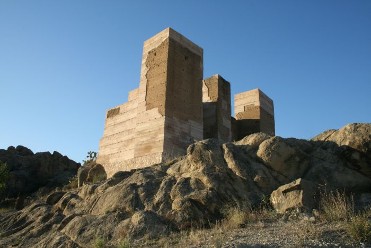
Built on the Peña Negra de la Sierra del Solán, at an altitude of 556 m and overlooking the town centre, stands this castle built in the 12th century by the Muslims. During the 13th century, the rebellion of Ibn Yusuf in Hud against the Almohads took place in this area. Negra, later called Blanca, suffered the clashes between the rulers of the region. In 1285, Sancho IV, King of Castile, gave the towns and villages of the Ricote Valley, including Negra, to the Order of Santiago. This order improved the yield of the land and converted the Mudejars from Blanca to Christianity. The castle was used as a watchtower and a refuge for the inhabitants of the neighbouring farmsteads in times of instability. It was restored between 2003 and 2006. The castle, which had become the symbol of the lordly power of the order over the valley and its inhabitants, was to be the scene of a resounding act of arms in the mid-15th century, in the context of the Murcian civil war and the clashes between the adelantado Don Pedro Fajardo and his close relative Don Alonso Fajardo "el Bravo". Thus, in 1448, a military action was directed against the fortress in which some pyrotechnic artillery devices were used, fuelled with eight arrobas of gunpowder bought in Orihuela. Architecture The most outstanding remains of the fortified complex are made up of three towers linked by two curtains where the cube in the centre is smaller than its flanking towers. This system enclosed the enclosure on one of its sides, and inside it there is a possible cistern set into the rock. From these structures we can see the beginnings of a barely preserved wall, which gives it an irregularly rectangular plan with the longest sides extending northeast-southwest. The preserved remains, which are clearly visible in these three towers, were built with tápiales. Also still visible are the mechinales that housed the planks that formed the modules of the construction of the wall, which is approximately 90 cm thick. According to Alonso Navarro, the towers may have reached a height of twelve metres, and show signs of having had two bodies and a crenellated terrace. They also have certain openings at the top, which may have been Saeteras. Other remains To the east of the fortification, on the highest side of the hill, there are also remains of constructions that may indicate a defensive construction from a chronological period prior to the one preserved today.
Youth hostels
Murcia
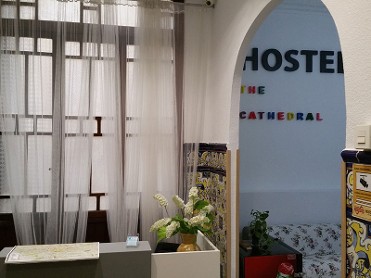
Hostel de Murcia situado en pleno centro de la ciudad. Estamos situados a escasos metros de la catedral en la famosa calle Trapería, vía principal del casco antiguo y con comercios, restaurantes y todo tipo de servicios. The Cathedral Hostel está situado en un precioso edificio clásico del siglo XX. En este se mezcla nuestras modernas instalaciones con los materiales nobles de la casa. Son espacios luminosos con grandes puertas de madera guardando su estructura de amplias dimensiones, suelos originales en diferentes colores y zócalo con dibujo arabesco. Disponemos de una sala común así como de una cocina compartida. Los baños están totalmente reformados. HORARIOS Check In de 12:00 a 14:00 h. y de 17:00 a 22:00 h. Check Out a las 11:00 h.
Rock art
Cieza
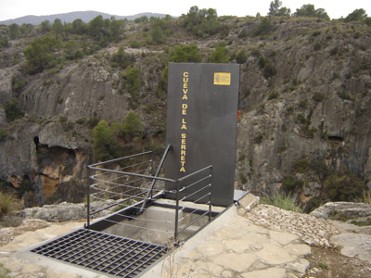
Se encuentra en el margen izquierdo del río Segura, en el borde del cañón cárstico de Los Almádenes. Otra apertura, de grandes dimensiones, se abre hacia el interior del mencionado desfiladero permitiendo una gran iluminación natural de las pinturas rupestres así como la zona más habitable de la cavidad. En total aparecen en la cavidad 50 figuras, repartidas en dos paneles y pertenecientes en su totalidad al Arte Rupestre Esquemático, que incluye en este caso algunas figuras del estilo seminaturalista.

Monuments
Cartagena
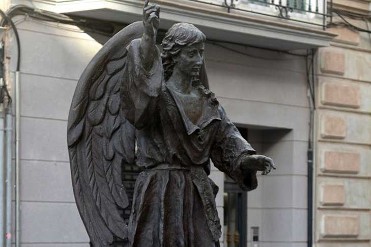
A sculpture representing the Guardian Angels in Carmen Street, by the sculptor Juan José Quirós from Cartagena. The statue, 1.8 metres high on a pedestal of 50 centimetres, it weighs 800 kilos and makes Cartagena the first city in Spain to have a monument in honour of the patron of the National Police Corps.

Teatro y humor
Torre Pacheco
THE LOCOS el show más personal de Pedro Ángel Roca . Un viaje hilarante y profundamente humano por las contradicciones de nuestra época, contado con el arma más poderosa que existe: el humor. A medio camino entre el monólogo, la improvisación y la catarsis colectiva, cada función se convierte en una experiencia única donde el público y el cómico comparten algo más que risas: una verdad compartida. Un formato vivo, impredecible y brutalmente honesto que transforma la fragilidad en oro. Y tú… ¿estás lo suficientemente loco para subirte a su barco? ?? Espectáculo recomendado para mayores de 16 años. Duración: 90 minutos https://www.notikumi.com/2026/10/23/the-locos-con-pedro-angel-rocas

Programación cultural
Águilas
THE LOCOS. PEDRO ÁNGEL ROCA Viernes 27 de noviembre, a las 21 horas, en el Auditorio y Palacio de Congresos Infanta Doña Elena. Entradas ya a la venta en www.bacantix.com, Casa de la Cultura y Museo Arqueológico.
Monuments
Cartagena
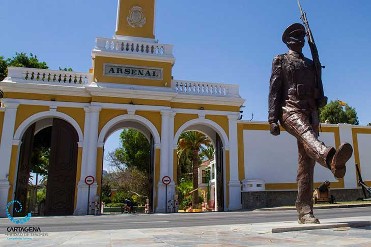
First monument of the country to the Spanish Marine, in Plaza del Rey in Cartagena. It consists of a life-size bronze statue of a Marine marching at a slow pace, made by the sculptor Jorge Aznar and which is added to other characteristic figures of the Armed Forces. With this monument, made with bronze pieces contributed by the Navy, it is paying homage to the Marines, one of the oldest units that exist in the city.
Monuments
Mazarrón
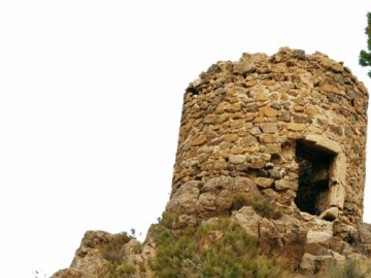
Elevated in a hill, the Molinete Tower can be found, also known as the Tower of the Catholic Monarchs. It is a watchtower in a circular shape, raised on a small promontory, close to Los Vélez Castle. The Molinete Tower was built by request of the Catholic Monarchs, who authorized it in 1490 as an appropriate structure for monitoring the coast. From its watchtower the coast could be controlled and measures could be taken for the area and the urban nucleus of Mazarrón to be protected against the frequent Barbary pirate invasions. The Tower is considered a Site of Cultural Interest.
Monuments
Yecla
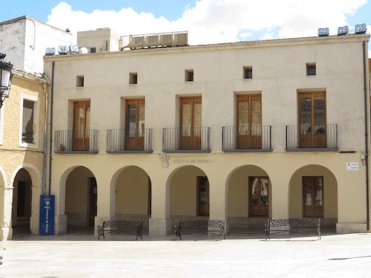
Originally, the building was probably built in the 16th century and it was initially used as a market. This building was right-angled built. On its ground floor an open or continuous gallery formed by ten round arches resting on square pillars stands out. At the end of the 19th century a new market was built, being several shops set up on its ground floor.
Active tourism
Murcia
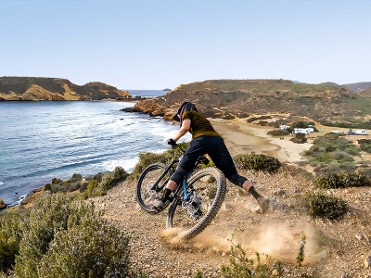
Agencia especializada en cicloturismo. Organización de vacaciones en bicicleta con todo incluido, y viajes guiados en bicicleta por la Región de Murcia.
Monuments
Puerto de Mazarrón (Mazarrón)
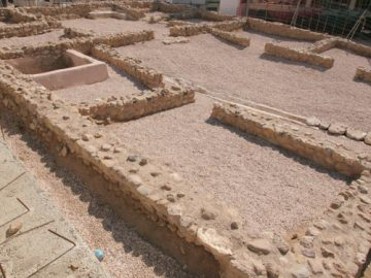
In 1990, at the back of the ancient port located in an area called La Era, a necropolis and some Roman single-family homes were excavated. The most complex houses had a hall, bedrooms, patio, kitchen and a cistern. They resembled classic Roman house models, with a central room around which the other rooms were centered. One of these houses was preserved by request of the Directorate-General of Culture, due to its scientific, historical and educational interest, and to the fact that it had been well preserved. The house mentioned has a surface of 300 m2 and is one floor, with the following structure: a large central room with a bench and plastered walls, interpreted as the triclinium, or hall. On each side of this room there are two symmetrical rooms which are entered through the main room. In the north side there is a large room with water channels or gutters wich have been identified as a possible atrium or vestibule. Around this patio the pattern of two symmetrical parallel rooms repeats, one serving as water storage with a 2 m deep pool, located next to what can be assumed the kitchen of this Roman house. The house of Calle Era formed part of the urban area of Port of Mazarrón in Roman times and was set up around another group of homes and a network of streets and small alleyways. These houses are the only clearly residential nucleus of the late Roman period studied to date. They were built at the same time that the salting factory was fully functioning and at its peak (the 4th-5th centuries A.D.). Rests of materials found in the homes, such as the high number of coins and the richness of the domestic goods indicate that the site belonged to a sector with significant acquisition capabilities. We assume that we are looking at a population nucleus dedicated to administrative or commercial activity connected to the salted fish industry, where people conserved Roman traditions, way of living and urban layout, although with a local market as indicated by materials and the structural system.
Monuments
Puerto de Mazarrón (Mazarrón)
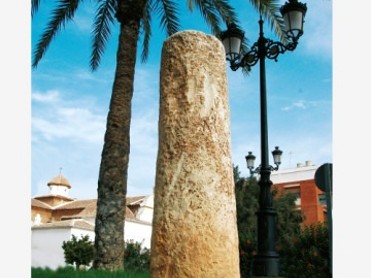
The Miliar term is applied to the posts, cairns or columns that were marking the distances in the ancient Roman roads. The Milestone of Mazarrón indicates the proximity of the Via Augusta road and has registered the following: "IMP.CAESAR DIVI F.AVGVSTVS COS XI TRIBUNIC.POTEST.XVI IMP.XIIII, PONTIFEX MAXIMVS.A LVCENTO EIOCROCAM.XXVIII MP REST". Translation: "Emperor Caesar Augustus, son of divinity, Consul XI times, tribunicia power XVI, Emperor XIIII, Pontifex Maximus, restored twenty eight thousand steps of the way from Lucentum to Eliocroca ".
Monuments
Cartagena
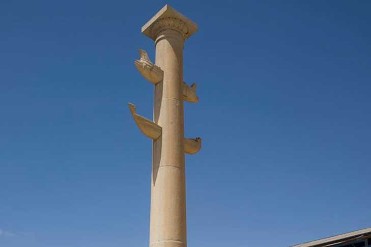
Commemorative monument of the centenary of the Board of Works of the Port in 1977. It is located in the port, next to the old Yatch Club and the Sailors' Training Barracks that currently houses new facilities of the Polytechnic University and the Naval Museum. The Rostral Column, a monument commemorating a naval battle that receives this name because its shaft is adorned with ship rams, was designed by Julio Mas García and his material execution corresponds to the sculptor Antonio García Mengual. The monument is made of stone from Sierra Minera in Cartagena-La Unión. At the base of the column several reproductions of amphoras were placed, alluding to the commercial character that has marked this port throughout its history.