Restaurants
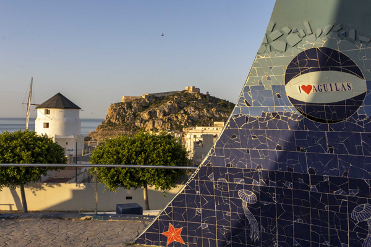
Águilas
Bar de tapas y restaurante Mi Barquito está ubicado en Plaza Alfonso Escámez , frente al puerto pesquero de Águilas. Tiene terraza. No se aceptan reservas.
Restaurants
Cartagena
Cocina cartagenera y con carácter. Cocina 100% hecha con amor. Los platos de toda la vida elaborados con el mejor producto local. Una selección de quesos y los mejores vinos de aquí y del mundo para disfrutar del placer de saber comer.
Monuments
Cartagena
Planned in 1785 as a naval academy and barracks, the building currently houses naval offices. With the exception of the top floor, few modifications have been made since its construction.
Monuments
Blanca
Located in the spot of Bujerca, in Huerta de Arriba, its purpose was to raise water from the principal canal in Blanca to irrigate around 2.7 tahúllas (0.30hz). The last functional wheel was the work of the master carpenter and hydraulic turbine inventor Antonio Molina Cano (1879-1953). His ingenuity led him to coin a type of wheel that he used in several waterwheels, such as those of La Quinta and Antonio Molina Cano, also in Huerta de Arriba. The Blanqueño craftsman would increase the number of spokes to eliminate the intermediate rim and thus make it lighter and with more inertia. Made of wood, except for the axle and metal plates, Miguelico Núñez's waterwheel was 8 metres in diameter, had 14 spokes, 42 blades and the same number of buckets arranged on its left crown. Although the waterwheel was well preserved in 1970, it would not be functional at the end of that decade, as its hydraulic space was irrigated with water from the "El Progreso" motor (1912). In 2002, it was rebuilt from the original shaft and plates, although with a tourist, not agricultural, function.
Monuments
Cartagena
El Arsenal de Cartagena comenzó a construirse oficialmente el 20 de febrero de 1731, bajo el reinado de Felipe V, y se finalizó en enero de 1782, bajo el reinado de su hijo Carlos III. Se barajaron un gran número de proyectos, siendo finalmente el propuesto por Sebastián Feringán el que mereció la aprobación. La primera obra que se ejecutó fue el desvío de la desembocadura de la rambla de Benipila, que en aquella época era un río de regular caudal, desde el Mar de Mandarache a la Algameca Chica. Se conservan la mayor parte de los edificios originales, lo que convierte al Arsenal en una joya histórica y arquitectónica que recibe cada año la visita de miles de turistas y personas interesadas en nuestra cultura e historia.
Museums
Cartagena
The building of the Real Parque y Maestranza de Artillería was built by order of King Carlos III. Its architecture is typical of the military constructions of the 18th century so widely represented in the city. The building was almost destroyed after being blown up at the end of the insurrection of the Cantonal War in 1874 and was not rebuilt until the beginning of the 20th century. The side façades better preserve the original appearance of the building. It is currently home to the Municipal Archive and the Military History Museum, which displays plans, models and documents showing the history of this weapon and its links with the city since 1508. It also houses a varied and extensive collection of artillery pieces, both field and coastal, anti-tank, anti-aircraft and mountain artillery, as well as a large quantity of ammunition, rangefinders, uniforms, souvenirs and a collection of military miniatures that has twice won the Guinness record for the number of pieces on display.
Tiendas especializadas
Murcia
Centro de estética con servicio de manicura, pedicura y tratamientos corporales y faciales en Murcia cerca de ti. Desde 2019 y ubicado en el palacio de Roche. Nuestras manicuristas y esteticistas trabajan con marcas como Comfort Zone, OPI o Neonail entre otras. Aparatología de Innova Pro. Tú salón de belleza de Murcia. HORARIO Lunes a viernes de 9:00 a 20:00 h.
Lugares de interés
Mazarrón
Proof of the rich Phoenician trade is that historians of the antiquity, as 'Diodorus Siculus, did chronicles like this: "... The Phoenician merchants who sailed to Iberia ... when his boat was overloaded with silver ... removed the lead from their anchors and, instead of lead, they did the stock of silver ". Phoenicians, Greeks and Carthaginians passed along our coasts until the Second Punic War brings the fall of 'Carthago Nova' (209 B.C.) and the Roman conquest. The Romans are those who undertake the greatest exploitation of the antiquity. Within the grounds of "Coto San Cristóbal” (“coto” means property) and "Los Perules" is "Corta Romana", popularly known as “El charco de la aguja” (Needle’s puddle). It’s a quarry which was originally a large front of mining works (extracting profit of the mines doing the required labours or excavations, fortify the area, arranging traffic in the enclosure and extracting usable ores), over 300m long, with an average height of more than 25m. Elsewhere in the town, as “Coto Fortuna” in Leiva, are conserved important works of Roman engineering like a draining gallery about 2km, one of the works of these most important characteristics of the Empire (not visitable nor visible because the gallery is located at 8 metres underground). The Roman company that exploited it, was named 'Societas Montis Argentaris Ilvcro', and ingots with this Roman company brand have appeared even into the Tiber, near the same Rome. The life of these miners must not have been easy, according of the finding of a human limb chained with shackles to a gallery. Mining developed during the Visigoth and Muslim period, although few testimonies were left. A large decline is perceived pointed to almost disappear. Mining industry rebirth with the Reconquista and the Christian settlements, and with it the “embryo” of what will be the current municipality of Mazarrón. Dependent on the Council of Lorca, it appeared the workers house called “Casas de los Alumbres de Almazarrón” (Houses of the Alum of Almazarrón). 1462, Henry IV of Castile granted the privilege of the exploitation of the mines to the marquisates of Villena and Vélez, keeping its splendour about 1592. Alum was used mainly as mordant to fix the dyes, exporting for the production of tapestries in the Netherlands. Also as an astringent and disinfectant intervened in leather tanning, lighting of codex and in glass manufacture. This mining wealth causes the segregation of the town and formalized in 1572 with the privilege letter signed by Philip II. In the 19th century, Mazarrón reached unprecedented and unexpected technological, economic and population levels. Free prospecting on public lands through a simple notification to the Administration, causes an authentic mining fever. Mazarrón grows rapidly and international mining companies decide to invest and modernize works. In 1886 a railway linked Mazarrón's mines with the foundry of Santa Elisa in Puerto de Mazarrón and, 1893, the mines already enjoy electricity. Thanks to its mines, Mazarrón leads the mining sector of Murcia and is situated at the national forefront. It came to undertake works up to 600m deep. At the entry of 20th century they started to feel the first symptoms of decline. Some reasons for this decline are: a) Flood of wells and incapacity for water evacuation. b) Drop in the prices of lead. c) Depletion of richest veins. d) Civil War. At the closing of the mines, Mazarrón suffers a significant emigration. Mazarrón has managed to adapt to the times recovering the ancient splendour with activities of other sectors such as tourism, the service sector,construction sector and tomatoes’ cultivation.
Children
San Pedro del Pinatar
Mingo Carnaval Ven con tu mejor disfraz y prepárate para pasarlo en grande. Junto a Mingo, Explo y las bailarinas del club de fans de Mingo, aprenderemos divertidas coreografías carnavaleras y disfrutaremos de una fiesta llena de color, ritmo y buen humor. El programa RUTEANDO CON MINGO 2026-2027 abarca diferentes actividades para que los niños puedan disfrutar con nuestra mascota Mingo y su inseparable Explo: Mingoruleta, Celebra el cumpleaños de Mingo, Mingoween, Mingo navideño y... ¡muchas más! Duración de la actividad aproximadamente de 1 hora. Si despues de 10 minutos del comienzo de la actividad no se presenta el niño/a, se cederá su plaza a otro de la lista de espera. Máximo 50 niños. Imprescindible que los menores vayan acompañados de un adulto. Inscripción previa necesaria aquí: https://www.sanpedrodelpinatar.es/concejalias/turismo/actividades-y-eventos/ruteando-con-mingo/ *Las inscripciones se abrirán un mes antes de la realización de la actividad. Ubicación: Plaza de la Constitución